
Views: 0 Author: Site Editor Publish Time: 2026-01-16 Origin: Site


Vlog | Industrial Tech & Motion Control
Updated for 2025
From electric vehicles and home appliances to drones and industrial automation, brushless motors are everywhere. If you’ve searched Google for “What is a BLDC motor?” or “Why are brushless motors better?”, you’re not alone.
As someone who closely follows motor technology, I can confidently say this:
BLDC motors are one of the most important building blocks of modern technology.
In this vlog-style article, I’ll walk you through the fundamentals of brushless DC motors, how they work, how they compare to brushed motors, where they’re used, and why manufacturers like SHINEMOTOR are heavily invested in this technology.
Brushless motors, more accurately called Brushless DC Motors (BLDC motors), are now widely used across consumer electronics, automotive systems, and industrial machinery.
Understanding how BLDC motors work — and why they outperform traditional motors — helps us better appreciate the technology powering our daily lives.
A brushless motor is an electric motor that operates without mechanical brushes. Instead of physical contact for commutation, it uses an electronic controller to manage current flow, speed, and torque.
This design delivers several critical advantages:
Higher efficiency
Longer lifespan
Lower noise
Reduced maintenance
Because there are no brushes to wear out, BLDC motors experience far less mechanical degradation. This makes them ideal for applications that demand quiet operation, reliability, and precise control.
BLDC motors are also compact and lightweight, which explains their popularity in drones, electric vehicles, medical devices, and smart appliances.
One of the most searched topics online is “brushless motor vs brushed motor”. Here’s a simple comparison:
| Feature | Brushed Motor | Brushless DC Motor |
|---|---|---|
| Maintenance | High (brush wear) | Low (no brushes) |
| Noise Level | Louder | Very quiet |
| Efficiency | Lower | Higher |
| Lifespan | Shorter | Longer |
| Control Precision | Limited | Highly precise (electronic control) |
Without brushes, BLDC motors eliminate friction and sparking, resulting in smoother operation and better performance. This is why brushless motors are now the preferred choice for long-term, high-reliability applications.
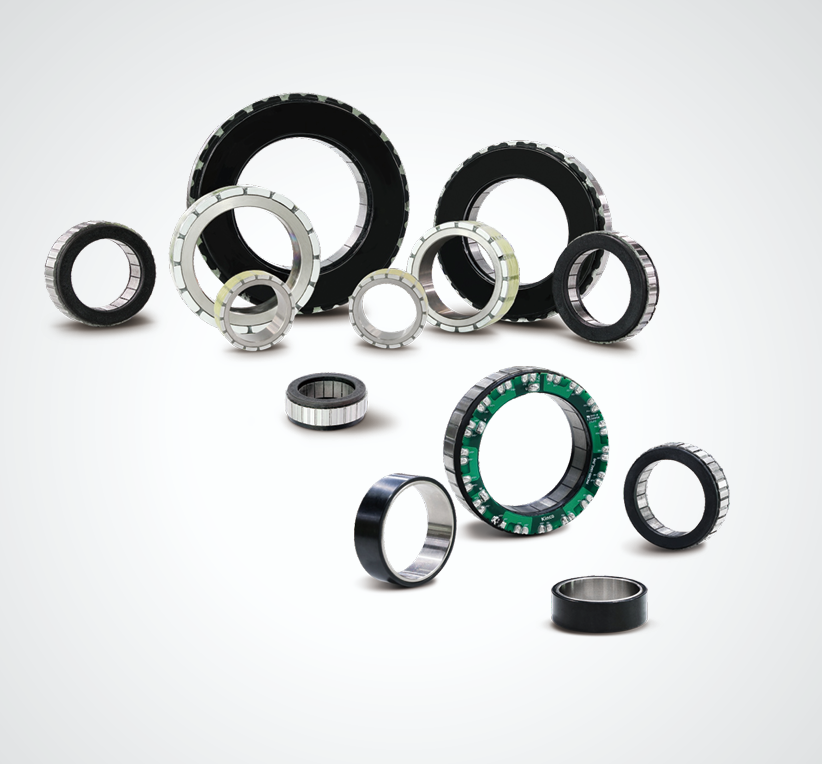
To understand how a brushless DC motor works, we need to look at its core components and how they interact.
A typical BLDC motor consists of:
Rotor – the rotating part, fitted with permanent magnets
Stator – the stationary part containing copper windings
Electronic Controller (ESC) – controls speed, direction, and torque
The controller sequentially energizes the stator coils, creating a rotating magnetic field. This field interacts with the rotor magnets, causing continuous rotation.
Unlike brushed motors, all timing and commutation are handled electronically, allowing for precise speed and torque control.
The interaction between magnets and coils is the heart of BLDC motor operation:
Permanent magnets in the rotor generate a constant magnetic field
Electromagnetic coils in the stator are energized in a specific sequence
Attraction and repulsion forces cause smooth, controlled rotation
This brushless design minimizes friction, improves energy efficiency, and significantly extends motor lifespan.
BLDC motors are everywhere in consumer electronics thanks to their small size, low noise, and high efficiency:
Drones – precise control and longer flight time
Laptops & PCs – cooling fans with minimal noise
Smartphones – vibration motors
Vacuum cleaners & washing machines
Their reliability and energy efficiency directly improve product quality and user experience.
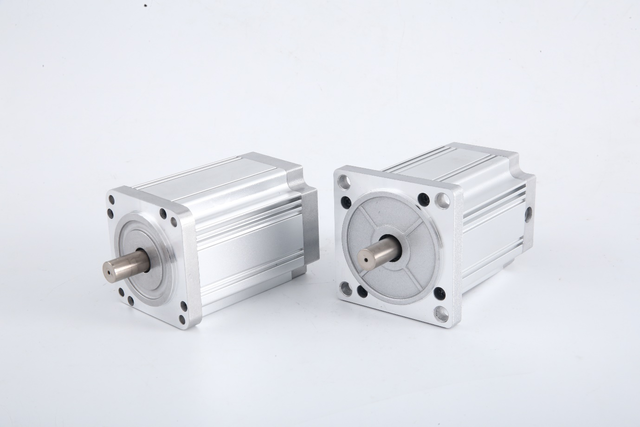
In industrial environments, BLDC motors are valued for uptime, efficiency, and durability:
Manufacturing automation – conveyors, robotic arms
Electric vehicles (EV motors) – propulsion and auxiliary systems
HVAC systems – energy-efficient climate control
These motors reduce maintenance costs while delivering consistent performance in demanding conditions.
One of the biggest advantages of BLDC motors is their long operational life:
No brushes to replace
Reduced mechanical wear
Better thermal management
This makes them a cost-effective solution over the long term, especially in continuous-operation systems.
BLDC motors are known as high-efficiency motors for good reason:
More electrical energy converted into mechanical output
Accurate speed and torque control
Extremely quiet operation
These features make BLDC motors ideal for applications where performance, energy savings, and noise reduction matter.
Selecting the right brushless motor requires careful evaluation.
Power and torque requirements
Speed range (RPM)
Size and weight constraints
Voltage and controller compatibility
Matching the motor correctly to your application ensures maximum efficiency and reliability.
Ignoring motor specifications
Overlooking system compatibility
Assuming BLDC motors require zero maintenance
While maintenance is minimal, periodic inspection helps prevent unexpected failures.
Manufacturers like SHINEMOTOR are helping drive BLDC technology forward by focusing on high-efficiency brushless DC motor solutions.
SHINEMOTOR typically offers:
Inner-rotor BLDC motors
Outer-rotor BLDC motors
Coreless (ironless) BLDC motors
Customized motor solutions for specific applications
By combining precision engineering with customization, SHINEMOTOR supports industries ranging from automation and medical devices to EVs and consumer electronics.
If you’re designing products for today — or tomorrow — understanding BLDC motor basics is no longer optional.
Brushless DC motors deliver:
Higher efficiency
Longer lifespan
Lower noise
Better control
It’s no surprise that BLDC motors dominate modern motion systems, and companies like SHINEMOTOR continue to push this technology forward.
If you enjoy deep dives into motor technology and industrial innovation, this is definitely a space worth watching ⚙️


